
UserTesting
Hustleworthy review and reader feedback for UserTesting
UserTesting is a usability testing service that pays participants to review websites and apps. Most tests take 15–20 minutes and pay $8–$10 via PayPal. With some users completing multiple sessions per month, earnings may reach $100 or more depending on invitation availability. It’s widely used by major tech companies seeking real user insights.

Money Making Expert
See user reviews
Is UserTesting Legit? Yes
Editorial review. Read our advertising disclosure.
Key Findings
| Overall Verdict | Highly regarded usability testing platform |
| Best For | Global testers with reliable payments |
| Realistic Earnings | $100–$500+ |
| Main Drawbacks | Test availability varies |
Expert Review
I would use UserTesting because the accepted tests are worth the time. The site is clean, the dashboard is easy to understand, and the payout rules are better than a lot of earning sites because there is no minimum withdrawal threshold. The only reason I would not rely on it every day is the screener rejection rate. That is the whole game. If I qualify, UserTesting can be one of the highest-paying small online tasks. If I do not qualify, it can feel slow. My realistic expectation would be $80 to $120 in a casual month, $200 to $300 in a strong active month, and around $400 only if I doubled the accepted-test volume and had enough matching screeners. I would keep it open, answer screeners honestly, and focus on getting good ratings rather than trying to rush every test.
UserTesting Review: My Honest Experience With Tests, Earnings, And Payouts
A detailed first-person style review focused on how the dashboard works, how much a realistic tester can earn, and what payout rules matter before signing up.
Quick Facts
| Payout detail | What I would tell a new tester |
|---|---|
| Minimum withdrawal | No minimum withdrawal. UserTesting pays each approved paid test instead of making you wait for a cashout threshold. |
| Payout option | PayPal only, so I would set up and verify PayPal before spending time on tests. |
| When payment arrives | Usually 14 days after completing a paid test, assuming the test is accepted. |
| Practice test | Unpaid. It is only used to approve the contributor account. |
| Best earning path | Standard tests plus higher-paying live conversations when they fit your profile. |
My Short Verdict
I like UserTesting more than most online earning sites because the work actually feels useful. Instead of clicking ads or grinding through tiny surveys, I am giving feedback on websites, apps, prototypes, surveys, and live research calls. The pay per accepted test is also much better than the usual survey site pay.
The part I do not like is the screener process. You can have ten available tests on the dashboard and still qualify for none of them. That does not mean the site is a waste of time. It means the money is in the accepted tests, not in staring at the dashboard all day.
If I were using UserTesting regularly, I would treat it as a high-paying side site that I check often, not something I depend on for steady daily money.
How UserTesting Works After Login
The contributor dashboard is simple. The main page shows available tests, surveys, screeners, and upcoming live sessions. Each card usually tells you the type of test, the reward, and what device or recording permissions are needed.
The basic idea is that companies want honest feedback from real people. For recorded tests, I would open a website, app, prototype, or task flow, then talk out loud while I use it. That talking part matters. If you stay silent, give short answers, or act like you are trying to rush through it, the test can be weak.
The site can ask for a microphone, screen recording, webcam, mobile device, or browser extension depending on the test. Some tasks are not recorded at all, especially simple surveys, but the better-paying opportunities usually expect you to speak clearly and explain what you are thinking.
Signup And Approval
The signup process is more serious than a normal survey site. I would expect to fill out a profile, connect PayPal, and complete a practice test before getting paid tests. That practice test is unpaid, but it is important because UserTesting uses it to check whether you can follow instructions and speak naturally while using a website or app.
The best way to pass is to slow down, read each task, and explain what you are looking at. You do not need to sound polished. You need to sound useful. A clear voice, quiet room, decent microphone, and honest feedback matter more than sounding like a professional reviewer.
Dashboard Experience
What I like about the dashboard is that it does not hide the important stuff. I can see available tests, the reward amount, and whether a test is a survey, recorded test, or live conversation. Live conversations also show the scheduled time and length, which is helpful because those require more commitment.
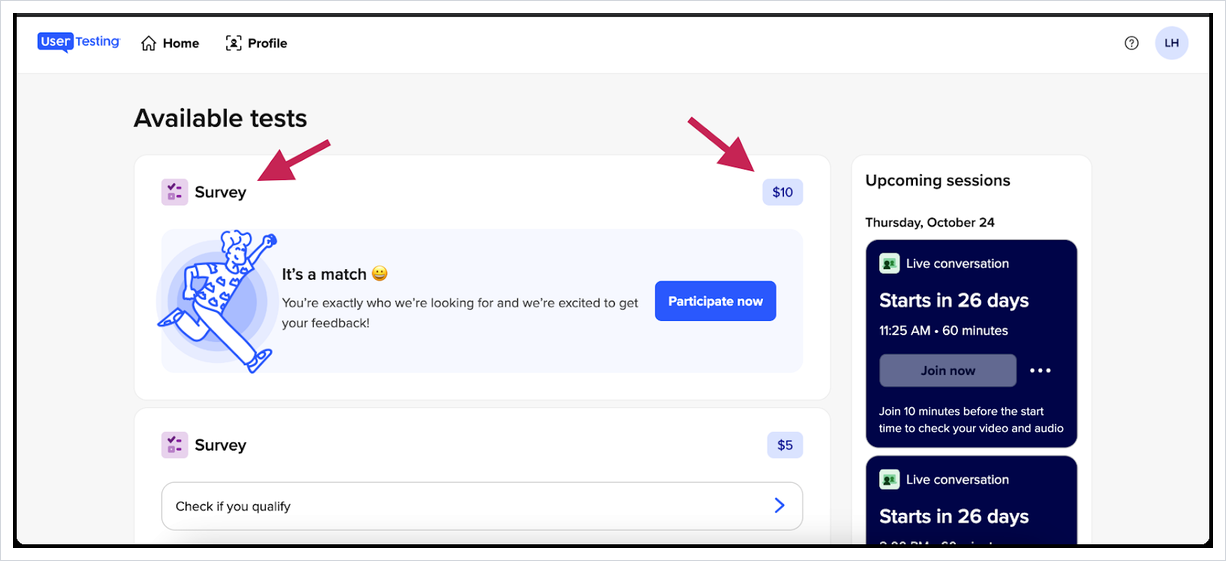
Inside the UserTesting dashboard: available tests, reward amounts, and upcoming live sessions.
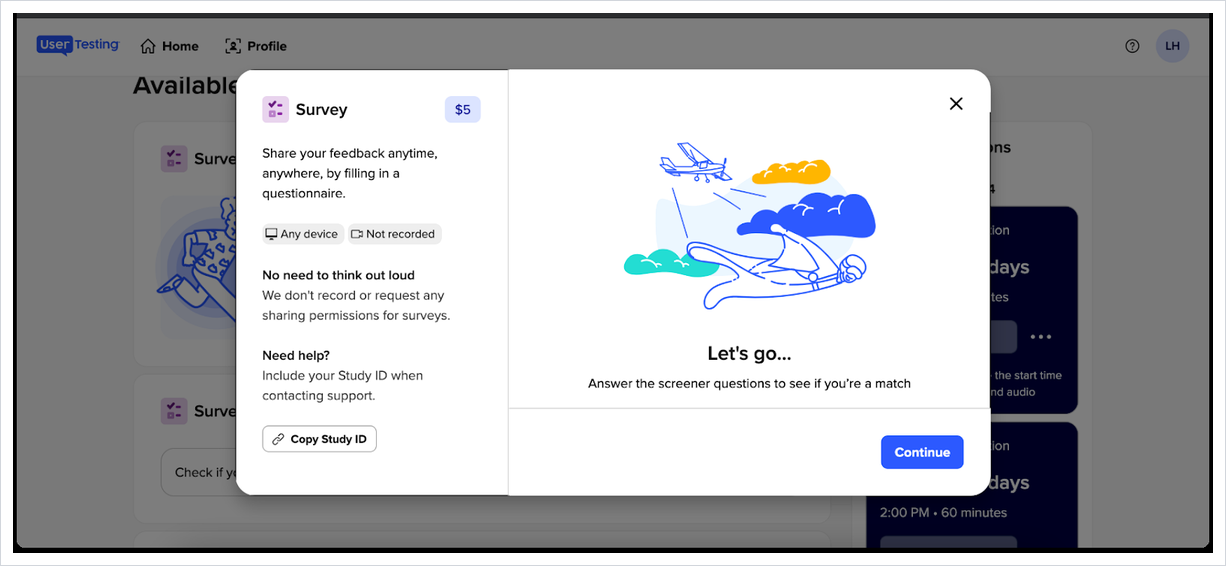
A test details screen shows the reward, device rules, recording requirements, and the next action.
Screeners Are The Main Bottleneck
This is the part that can be frustrating. A screener might ask about your job, shopping habits, software, phone, banking habits, travel, games, or business tools. If your answers do not match what the client needs, you are out.
That can feel annoying when it happens five times in a row, but it also makes sense. A company testing accounting software does not want feedback from someone who has never used accounting tools. A brand testing a grocery app may want parents, specific stores, or a certain shopping frequency.
I would not lie on screeners to qualify. That can backfire fast because the actual test usually exposes whether you really match the profile. I would rather get rejected quickly and wait for a better match than waste 15 minutes and risk a bad rating.
How Much I Would Expect To Earn
The cleanest way to think about earnings is by accepted tests, not by hours sitting on the site. A normal recorded test is often around $10. Short surveys or shorter tasks can pay less, and live conversations can pay more because they take a scheduled block of time.
For casual use, I would expect something like $80 to $120 in a month if I completed around 8 to 12 standard $10 tests. That is not a crazy target if the dashboard gives you enough screeners and you check it regularly.
For a stronger month, I would treat $200 to $300 as a realistic active-user range. That would mean roughly 20 to 30 standard tests, or fewer tests if some of them are live conversations. A moderate real-world benchmark I saw was $218 in about a month without treating it like a full-time project. If I doubled that accepted-test volume, I would aim for roughly $400 in a month, but only if the screeners matched and the dashboard stayed busy.
The pay rate during an accepted test can look great. A $10 test that takes 10 to 15 minutes is strong money for the time spent inside the test. The catch is that the unpaid time matters too. If I spend 30 minutes failing screeners before landing one $10 test, the real hourly rate is lower.
Minimum Withdrawal And Payout Options
This is one of the cleanest parts of UserTesting. There is no minimum withdrawal amount to hit. UserTesting pays per approved paid test, so I am not stuck trying to earn $20, $30, or $50 before I can cash out.
The payout option is PayPal. That is the key thing to know before signing up. If I did not want to use PayPal, UserTesting would be a bad fit for me. Payments usually arrive 14 days after completing a paid test, assuming the test is accepted.
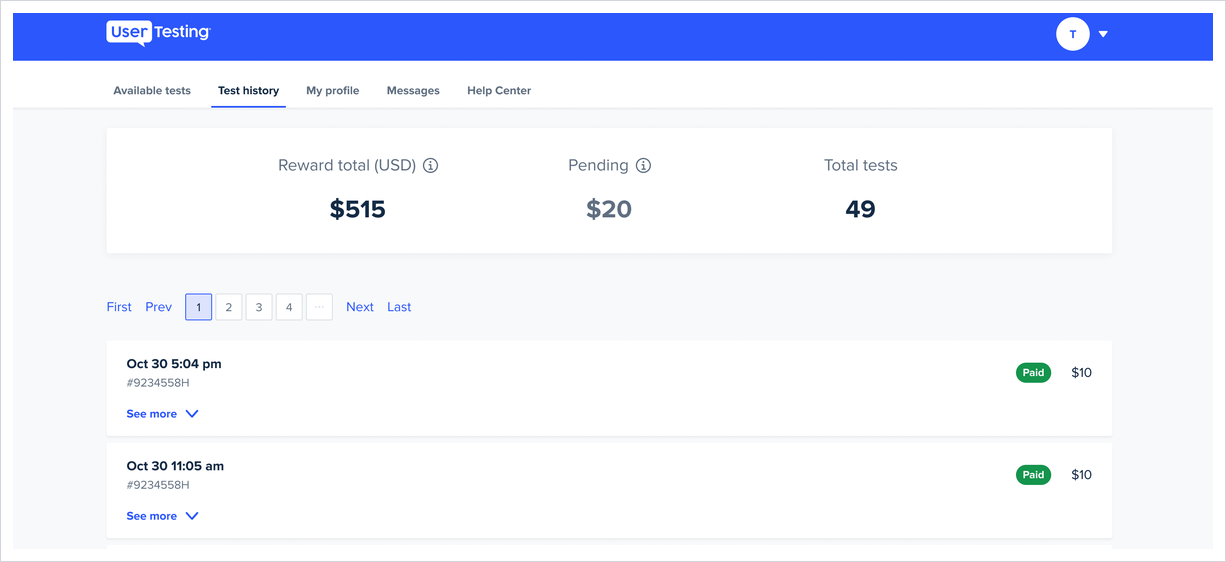
The Test history area shows reward totals, pending money, paid tests, and test status.
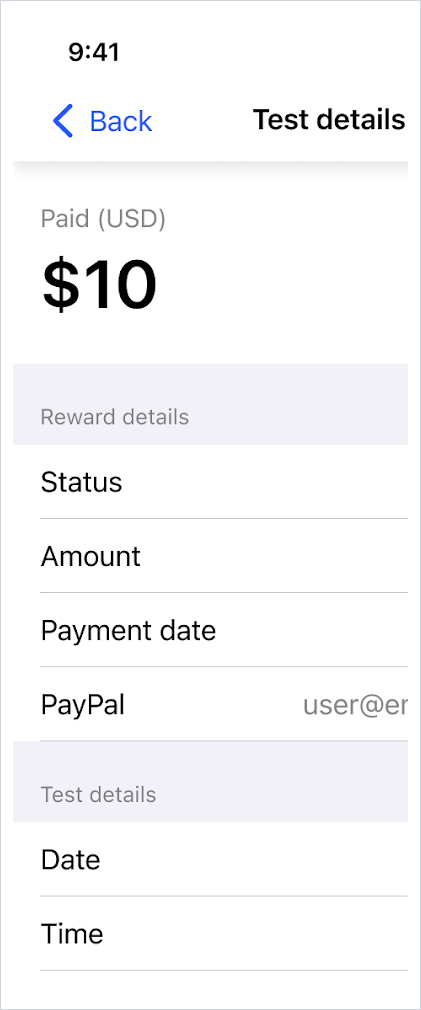
Mobile payment details show paid amount, payment date, and PayPal information.
What The Tests Feel Like
The best tests are straightforward. I open the task, read the instructions, and talk through what I am doing. If a button is confusing, I say that. If a page feels slow or messy, I say that. If something works well, I say that too.
I would not overthink it. The site is not paying for a perfect script. It is paying for clear reactions from a real user. The more specific the feedback, the better the test feels. Saying "this page is confusing" is okay. Saying "I do not know which button to press because the pricing button and demo button look equally important" is much better.
Live conversations are different. Those are scheduled calls, usually with a researcher asking questions in real time. They can pay better, but they are more intense because you need to be available at a specific time and answer follow-up questions on the spot.
What I Liked
- The pay per accepted test is strong compared with normal survey sites.
- The dashboard makes the reward amount clear before I start.
- There is no minimum withdrawal threshold.
- PayPal payout is simple if PayPal is already part of your setup.
- The work is more interesting than basic surveys because I am reacting to real websites, apps, and product ideas.
- Mobile and desktop opportunities both exist, so I am not locked into one device all the time.
What I Did Not Like
- Screeners can reject you over and over, which can feel like a waste of time.
- You need to be comfortable recording your screen, voice, and sometimes your face.
- Test availability depends heavily on your profile and timing.
- A good day can look very different from a slow day.
- Live conversations pay well, but they require scheduling and more attention.
- If your audio, internet, or device setup is bad, you can lose good opportunities.
Tips I Would Use To Earn More
- Keep the profile updated because the site uses it to match tests.
- Check the dashboard during normal business hours when companies are more likely to post research.
- Answer screeners honestly and quickly.
- Use a decent microphone and test the setup before taking recorded tests.
- Speak your thoughts out loud during every recorded task.
- Take live conversations only when you can sit down, focus, and answer properly.
- Do not chase every test. If the topic is a poor fit, skip it and wait for a better match.
Who I Think UserTesting Is Best For
UserTesting is best for people who can explain what they are thinking while using a website or app. If you are comfortable talking out loud, sharing your screen, and giving direct feedback, it is one of the better online earning sites to keep in rotation.
It is also better for people with flexible time. If you can only check once a week, you may miss good tests. If you can check a few times a day and respond quickly, your odds are better.
User Reviews | UserTesting
Current average review
Based on 2 user reviews

Oscar Romano
I tried UserTesting as a way to earn some extra income. To take part, I had to record both my microphone and screen, which made me hesitant at first because of privacy concerns. The process is real, but getting accepted for tests is difficult. I’m screened out of about 95% of opportunities, and when I do qualify, the payout usually arrives after 14 days. The platform itself can be glitchy at times, yet I’ve seen people make around $200 to $300 per month if they qualify often enough. Personally, I’ve only managed very small earnings. In comparison, I’ve had better luck with other research platforms where the rejection rate feels lower and the time feels better spent.
Thomas Williams
When I first started with UserTesting, it felt like a waste of time. I went through dozens of screeners and kept getting rejected. After a few weeks, I began qualifying for 1–2 tests a day. Over the past three months, I’ve averaged about $60 a week, with my longest test lasting 13 minutes. Mobile screeners have given me the best results. In one year, I managed to make around $5,000. I know people who’ve made as much as $10,000, but for me, the income has been solid side money rather than a main source. I once landed a single assignment that paid $90, and on a good day, I’ve earned up to $100. The downside is how strict they are with live interviews. Out of about 40 I did, I had to cancel 2 within 24 hours and ran into 2 technical issues on their end, which eventually got me banned. Overall, it depends heavily on demographics, patience, and consistency. If you stick with it, the platform can pay, but it’s not reliable enough to count on as steady income.